


We got beat in the 2019 state semifinal after leading 21–0 at halftime.
Final score: 22–21
The play that got us?
Mesh.
As disappointing as that loss was—and honestly, still is—we simply got outcoached.
Their staff invested the time to truly study the Air Raid. Instead of becoming a spread team, they borrowed some of its most effective passing concepts and blended it into their traditional Pro-I offense. The result was an offense that became nearly impossible to stop.
With the game on the line, they elected to go for the two-point conversion and the win. They called Mesh from a condensed bunch formation, executed it to perfection, and hit the OTB (Over-the-Ball) route to their big receiver.
The rest is history.
They had talented players, but their coaching staff maximized every ounce of that talent. There’s a reason their head coach is a 3x New York State Coach of the Year.
Sometimes, you just have to tip your cap.
That loss also taught me something valuable: if one passing concept could completely change a game, I needed to understand it inside and out.
This article is that guide.
What Is 92 Mesh?
At its core, Mesh is nothing more than a basketball pick play disguised as a passing concept.
One receiver becomes the “setter”, creating natural traffic in the middle of the field, while the faster receiver crosses underneath him. The two receivers “mesh” together approximately 4–6 yards beyond the line of scrimmage before separating.
Against man coverage, the crossing routes naturally create rubs that force defenders to fight through traffic.
Against zone coverage, the receivers simply settle in the open windows once they identify soft spots.
It’s an incredibly simple concept, yet one of the hardest to defend.
Why Mesh Is So Effective
The beauty of Mesh is its versatility.
It works against both man and zone coverage and can be installed from almost any formation:
2x2
3x1
Empty
Deuce Gun
Bunch
Stack
Condensed formations
If a defense doesn’t have an answer, an offense can continue calling Mesh until the defense proves it can stop it.
Few passing concepts have that kind of staying power.
The Coaching Point That Changed Everything
One reason Mesh can be confusing to teach is figuring out which receiver goes underneath on the crossing routes.
This is where Air Raid legend Mike Leach made it simple. The Y is always the setter. The Y receiver always runs the 6-yard mesh route, serving as the “pick” in the concept. The opposite receiver always works underneath the Y.
That single coaching point removes the confusion. Regardless of the formation, every receiver knows exactly where they fit in the concept.
Once you understand the rule “Y is the setter”, Mesh becomes much easier to teach, install, and execute.
The Double Pick Mesh Variation
Now for the variation of Mesh I wanted to highlight in this article, “The Double Pick.”
It’s hard enough to cover the base mesh play. This double pick variation makes it essentially impossible. Here’s the concept.
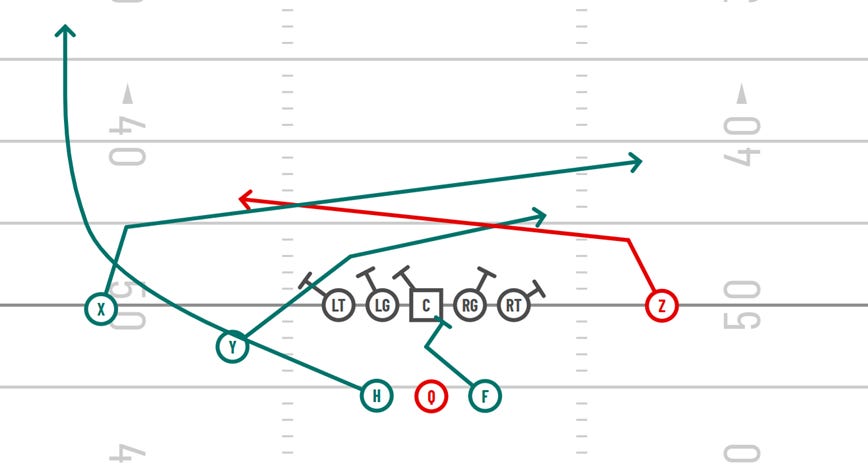
The double pick variation adds another setter above the Y WR. The Y will set up the pick for the linebackers while the X WR sets the corner trying to chase across the formation to stay with the Z WR.
It ends up being a double rub with full intention of hitting the underneath route, running through man or settling right in front of the double pick.
The RB wheel is another very dangerous aspect of this play. If the outside linebacker carries the wheel route, the flat window for the underneath WR is wide open. If the outside linebacker doesn’t cover the wheel, he is uncovered up the sideline for a TD.
Mesh From a 2x2 Formation
Mesh From a 3x1 Formation
Mesh From Empty
Final Thought
Mesh is important regardless of the offense you run. It’s a simple concept that gets WR open regardless of coverage and formation. Remember, regardless of formation “Y is the setter” this will allow you to establish the base rules for your players and make it easier as formations change. The “Double Pick” with the RB wheel is my favorite variation and I hope I never have to defend it.
