


Ever since Montana State won the 2025 FCS national championship, I have spent a lot of time studying the Bobcats’ offense.
What initially caught my attention was their quarterback run game. During the 2025 season, offensive coordinator and quarterbacks coach Pete Sterbick used concepts such as Power Read and QB Jet Power Read, often pairing them with A-gap power blocking to make the quarterback a featured part of the rushing attack.
But as I began studying Montana State’s offense in 2026, I noticed a change.
The Bobcats have not removed the quarterback from the running game, but Sterbick appears to have condensed Jet Power Read and Power Read into one simpler play: Midzone Read.
I am a huge fan of the change.
Midzone Read combines two elements that, in my opinion, make a running play extremely difficult to stop.
The first is the natural cutback lane. Through repetition in practice, the running back can be trained to press his aiming point and hit the cutback until the read becomes instinctive.
The second is option football. If a defense does not spend enough time practicing its option responsibilities or if you are facing an overly aggressive defensive coordinator, you can use that aggression against them. The quarterback read forces the backside defender to remain disciplined. If he crashes on the running back, the quarterback pulls the ball for a huge gain.
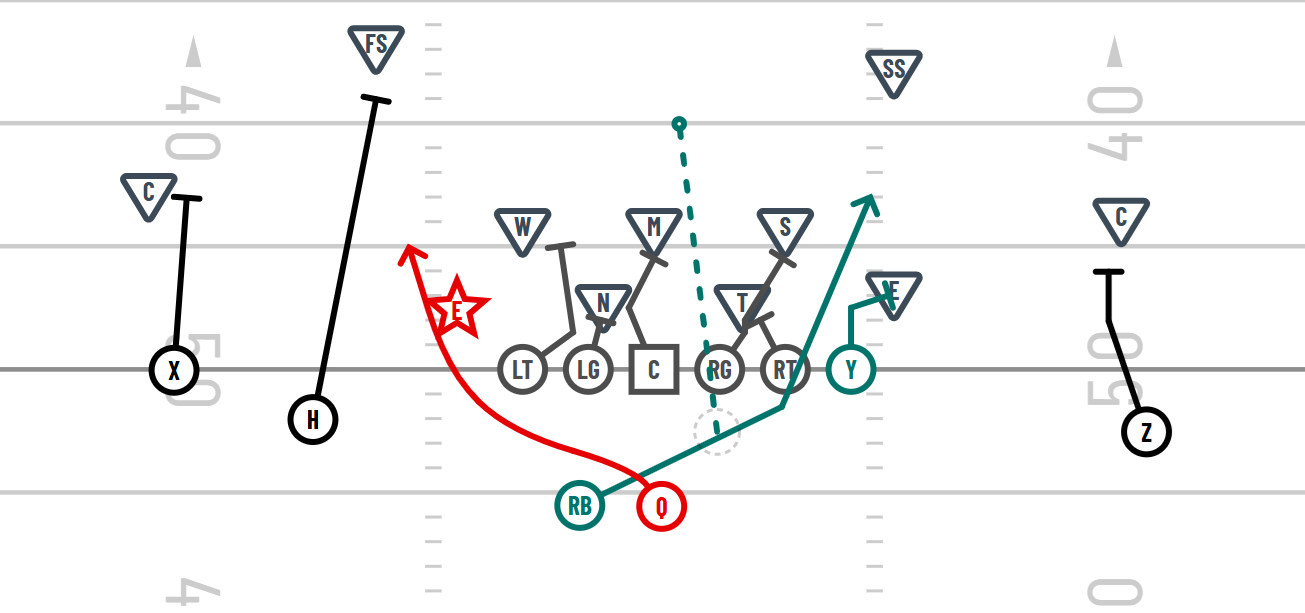
At first glance, Midzone Read does not look particularly complicated or explosive. The offensive line uses straightforward zone rules, the running back presses the C gap, and the quarterback accounts for the backside defender.
But that simplicity is exactly what makes the play effective.
The Basic Structure
Montana State will typically run Midzone toward the tight-end surface.
The tight end is responsible for the D gap. If a defender is aligned as the last man on the line of scrimmage, the tight end base-blocks him. If the D gap is unoccupied, he can work to the widest linebacker. The tight end is taking the end man on the line of scrimmage where he wants to go. Which is a much easier block than a reach on a 9 technique on outside zone. To me, this is why midzone is better than widezone, your not relying on your TE to make a tough reach block on a defensive end that is trained to read your reach step off the snap.
The offensive line follows a simple rule:
Reach your playside gap. If your gap is open, help backside on a combination block and climb to the linebacker. Nothing crosses your face on the backside.
These rules allow the offense to handle different defensive fronts without constantly changing assignments. If the defense runs twist games with the C and D gap. The TE blocks the D gap and the tackle blocks the C gap. These should eliminate some confusion for the lineman on the twist pickup if they simply stay true to their gap rules.
Press the C Gap, Hit the Cutback
The running back’s aiming point is the outside foot of the playside tackle.
That landmark puts him on an initial C-gap track and forces the defensive front and linebackers to flow laterally.
This is where Midzone differs from Inside Zone. The wider track places more horizontal stress on the defense, but the back is not simply trying to reach the sideline. Montana State is using the threat of an outside run to create an opportunity to get vertical.
The back’s progression is:
Press the C gap.
Cut through the playside B gap if the defense stretches.
Bend into the A gap if the interior opens completely.
The natural B-gap cutback is my favorite part of the play.
As the offensive line reaches toward their playside gaps, the linebackers begin flowing with what looks like Outside Zone. If the C gap closes, the running back can plant and get vertical underneath that movement.
The back must remain patient. If he cuts inside too early, the linebackers never have to respect the C-gap threat. By pressing the outside foot of the tackle, he helps create the cutback lane for himself.
Threaten the C gap, stretch the Dline and linebackers and hit the B gap when the defense overplays the zone action and the Offensive lineman drives their block past the hole.
If the defense stretches even farther, the back can bend the run through the A gap. Although the entry point changes, every option develops from the same initial track.
Reading the Backside End
While the running back works the front side, the quarterback reads the backside end.
If the end respects the quarterback, the ball goes to the running back and the defender has effectively removed himself from the play. If he closes aggressively toward the handoff, the quarterback pulls the ball and replaces him off the backside.
This is where Midzone Read differs from Montana State’s earlier Power Read package.
On QB Power Read and QB Jet Power Read, the quarterback could become the primary interior runner behind A-gap power blocking. Which made your QB run up the middle, which isn’t ideal. On Midzone Read, the running back is the primary ball carrier. The quarterback’s job is to prevent the backside defender from chasing the play freely.
Sterbick has not eliminated the quarterback-run threat. He has found a way to use that threat without requiring the quarterback to absorb as many designed carries between the tackles.
Changing the Presentation
Montana State can dress up Midzone Read without changing its foundation.
Jet motion can widen a linebacker or influence the read defender. An H-back or wing can provide another blocker at the point of attack. Montana State can also run the concept from different formations while keeping the same aiming point and blocking rules.
The tight end owns the D gap.
The line reaches its playside gaps.
The running back presses the outside foot of the tackle.
The quarterback accounts for the backside end.
That allows Montana State to appear multiple without installing several unrelated running plays. In the clip, you notice the TE and H back to the same side of the formation. This picks up an extra blocker.
A Run to Stay Ahead of the Chains
Midzone Read may not produce an explosive gain on every snap, but it does not need to.
What stood out on film was how consistently Montana State gained positive yardage. The Bobcats repeatedly picked up three to five yards and stayed in manageable down-and-distance situations.
That makes Midzone Read useful on first down and in short-yardage situations.
Why I Like the Change
Montana State’s Midzone Read combines everything I want from a foundational running play.
The blocking rules are simple. The running back has a clearly defined aiming point. The quarterback accounts for a backside defender without requiring another blocker, and the offense can run the concept from multiple formations.
Most importantly, the play uses the defense’s pursuit against itself.
Sterbick has simplified Montana State’s quarterback run game without abandoning what made it dangerous. The quarterback remains a threat, but the offense no longer needs to rely on him as the featured ball carrier. Midzone Read may not look like much at first, but it provides simple rules, multiple answers and consistent positive yardage.
That’s why I am becoming a huge fan of Midzone Read and I think we’ve only scratched the surface on how prevalent this running play will become in the not so distant future.
Adam MaCauley is the face behind Simple Football Systems. If you’d like to read and watch more of Adam’s content subscribe to his YouTube page by clicking here.
