


I started watching Tarleton State because of the numbers they were putting up offensively. A quick Google search of “Who led the NCAA in scoring?” was really all it took to make me stop and ask, who the heck is Tarleton State? No offense to anyone already familiar with the program. I hear things are really taking off down there, but being from New York, the buzz around Tarleton State hadn’t exactly made its way up here.
Tarleton State averaged over 42 points and 457 yards per game, while averaging 6.6 yards every time they snapped the football. They finished the season with 77 offensive touchdowns and a 12–2 record.
Naturally, I wanted to see what they were doing. To my surprise, the offense isn’t all that flashy. If I had to summarize it, Tarleton State blends old-school gap-scheme runs with the modern RPO game. They aren’t reinventing offensive football; they’re taking concepts that have been around forever and pairing them with answers that make those concepts harder to defend.
The next thing I wanted to figure out was simple: What run play do they hang their hat on?
Pretty quickly, one play kept showing up.
I’ve been calling it G-Wrap. I don’t know what Tarleton calls it internally, but it’s a gap-scheme run with the backside guard pulling.
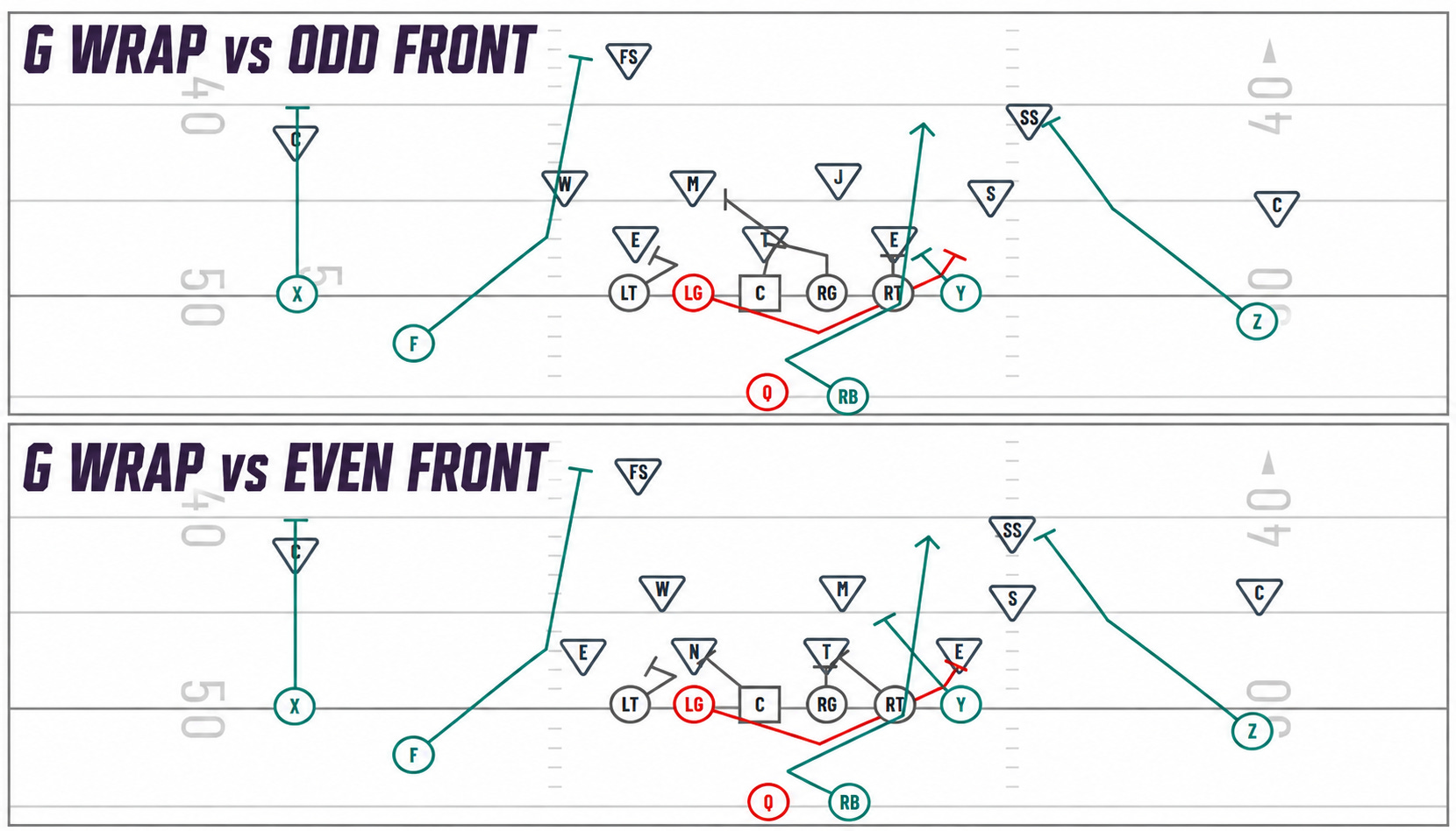
What you’re seeing is a pretty clean gap scheme structure. The backside guard is pulling, the line is working down blocks and double teams, and the back is reading the puller rather than just hitting a predetermined hole.
The Core Idea: Gap Scheme With a Read Element
At its core, this is a simple gap scheme run. It’s the kind of play most offensive lines can install without a ton of stress. You’re not asking linemen to reach everything or handle wide zone rules. You’re asking them to down block, create movement, and let a puller insert.
That matters, especially when you’re dealing with different pressures.
Gap schemes are naturally good versus blitz because they create immediate answers inside. If the defense adds bodies, the run still has a defined structure. You’re not chasing defenders horizontally, you’re creating a vertical crease and inserting a blocker into it.
But what Tarleton does well is they don’t treat the run as static. G Wrap isn’t 36 Power, where we are trying to hit the C gap every single time. There is much more built in freedom for the pulling guard and the running back. This is why I love this play. The defense might be able to stuff the C gap on 36 Power by reading the guards pull, but now the offense has the freedom to simply bounce the play outside.
The running back is not just following the guard blindly. He’s reading the puller and reacting to his block.
The Two Ways It Can Hit
This is where the play becomes more than just a standard gap scheme.
The back has two real options based on what the pulling guard does:
If the guard kicks out the edge defender, the run hits inside of that block.
If the guard logs the defender and turns him in, the back can bounce outside.
G Wrap turns a traditional power play into something that behaves more like a zone concept.
You’re still blocking gap rules up front, but the back has the ability to make the linebackers wrong in their run fits.
Why It Works
The reason this concept is so effective is pretty straightforward.
First, it’s easy to install. Offensive linemen understand gap scheme rules quickly. Down blocks, double teams, puller—there’s not a lot of ambiguity.
Second, it handles pressure well. If defenses try to add bodies or blitz the interior gaps, the structure of the play still holds. The puller becomes the answer.
But the third piece is what really separates it.
The running back doesn’t have to be perfect. He’s not guessing pre-snap. He’s reacting post-snap to one key block—the puller. That simplifies the decision-making and keeps the play efficient even when the defense is moving.
So you get:
Simple blocking rules for the line
A built-in answer for blitz
A read element for the back that adds flexibility without complexity
That’s a hard combination to defend consistently.
Where It Starts to Stress Defenses
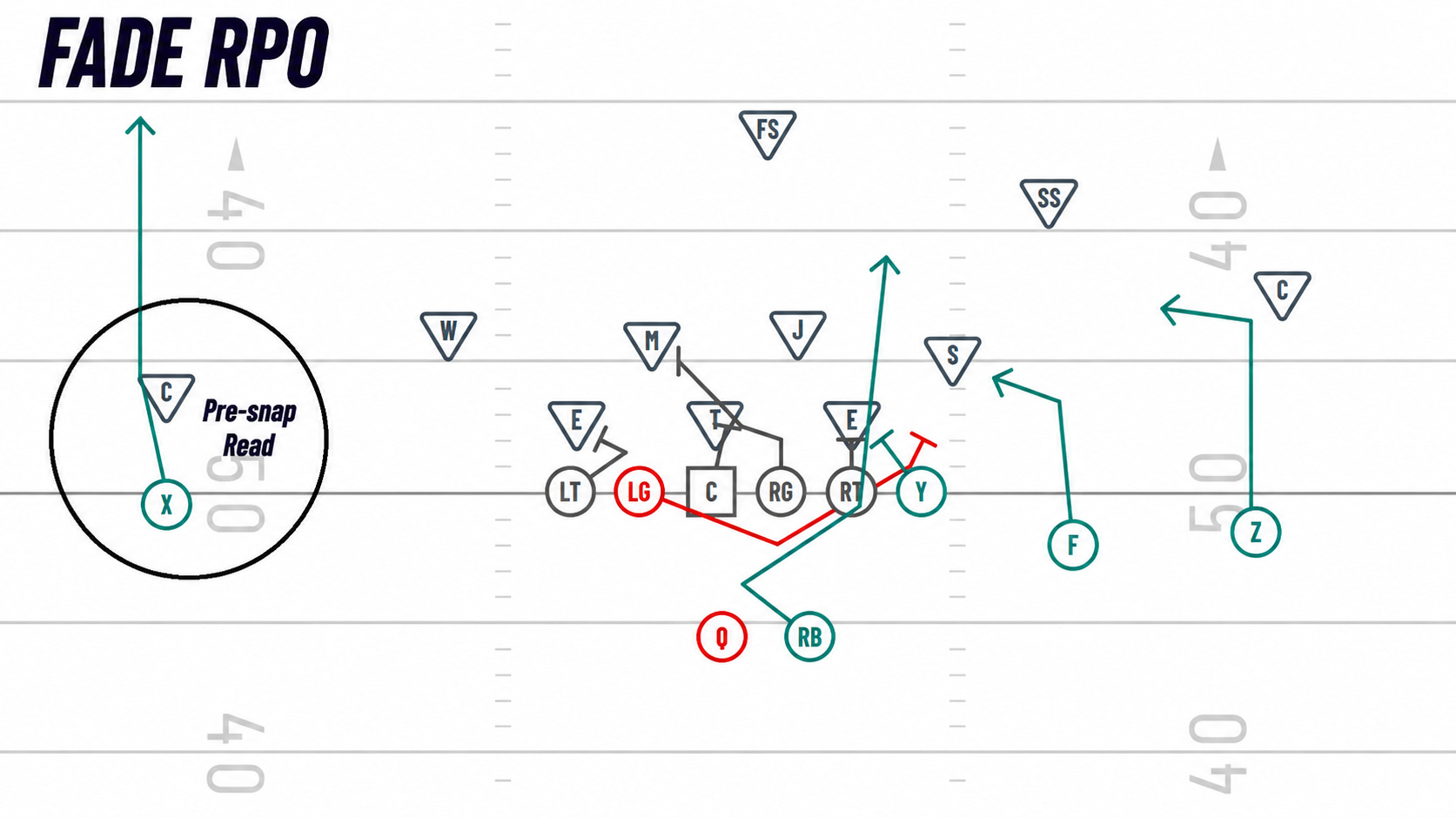
Once defenses start fitting the run, Tarleton State uses a tagged RPO system off their G Wrap play. The most often used RPO is “glance” which I call Slant RPO. They also tag quick screens off G Wrap run action and pre-snap read the single WR side out of trips to go vertical off run action.
Slant “Glance” RPO
With the guard pulling towards the TE, the middle linebackers naturally have to react to the pull. This opens up the backside slant, if the outside linebacker hangs with slot WR’s slant, we have a dig behind the 1st slant, in the second window.
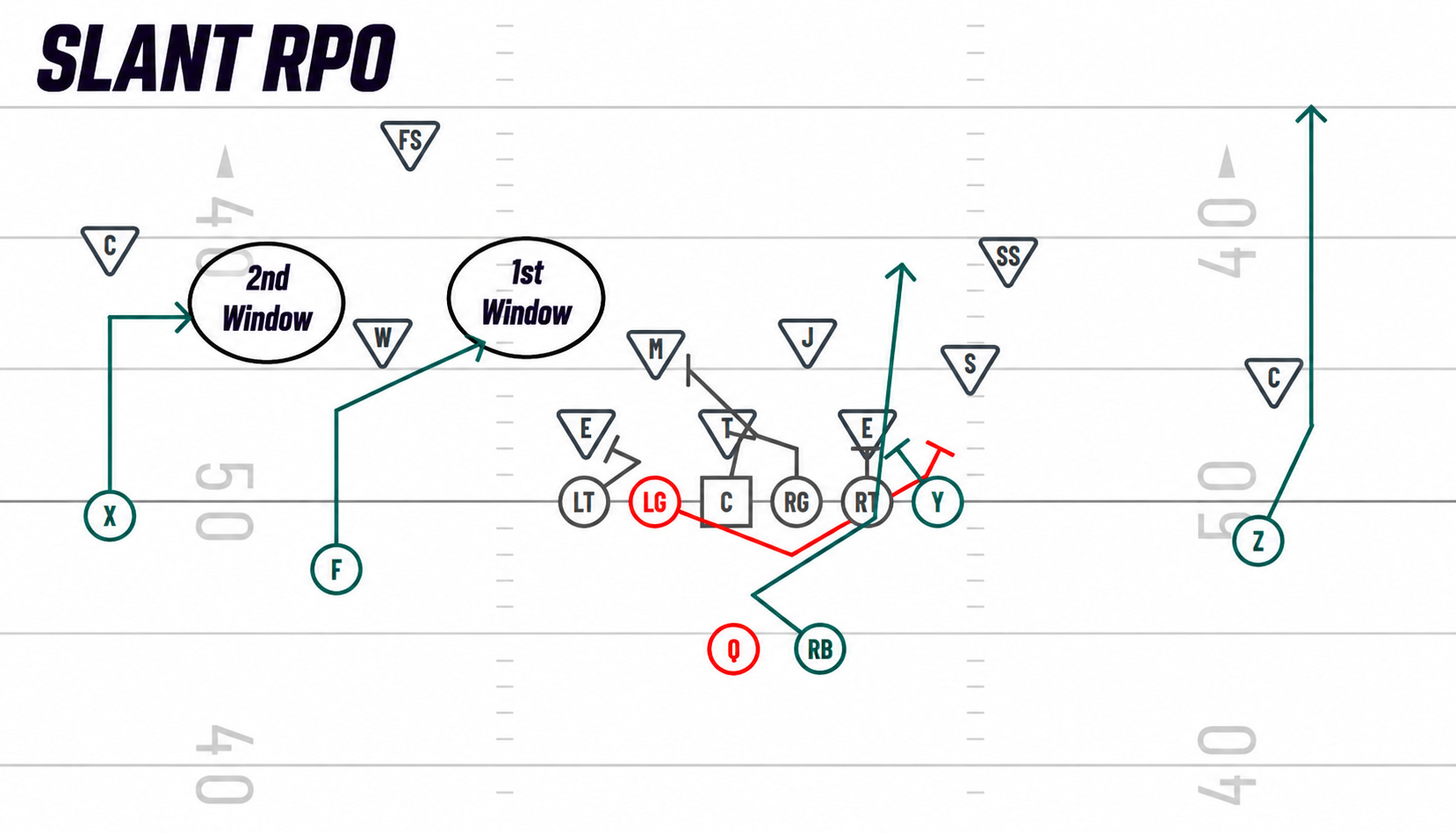
What you’ll notice on this clip is how quickly the linebackers trigger downhill. That’s exactly what the offense is trying to create. The run action forces a reaction by the linebackers opening up a nice throwing lane.
Fade RPO
When I think of an RPO I think of short quick routes: Sticks, Arrow, Glance. Tarleton State uses a vertical route in their RPO, which really stresses the defense. They will align in trips, isolating the X WR and pre-snap check to a fade ball, everything remains the same upfront. What a great way to hit big plays!
The Bigger Picture and Final Thoughts
When you put it all together, G-Wrap isn’t just a run play.
It’s the cornerstone of what Tarleton State’s offense is built around.
You’ve got:
A base gap scheme run that is simple and physical
A running back read that adds flexibility without adding complexity
RPO answers that punish overcommitment
What stood out most watching Tarleton State was how traditional this explosive offense actually is. Pro-I teams build their systems around ISO, Wing-T teams build their system around Buck Sweep, Tarleton State builds their system off of G-Wrap.
The run is the foundation. The running back read element gives it flexibility. The RPOs turn it into a modern system.
When everything is tied together you have something that is challenging to defend, and you end up leading the NCAA in scoring.
Adam MaCauley is the face behind Simple Football Systems. If you’d like to read and watch more of Adam’s content subscribe to his YouTube page by clicking here.
Awesome breakdown.
Thank you Cody.