


The Jaguars are coming off a 13-win season heading into 2026, and a huge piece of that was the defense.
Anthony Campanile’s first year in Jacksonville produced a unit that finished 8th in points allowed at 19.8 per game, fielded the No. 1 run defense in football at 85.6 yards per game, and ranked 2nd in the league with 31 takeaways. That is a defense that wins games. It is also a defense with an obvious hole in it. The Jaguars finished with 32 sacks, 27th in the NFL, and ranked 29th in sack rate and 20th in pressure rate. Elite against the run, elite at taking the ball away, bottom third at getting the quarterback on the ground.
Year two is where that gap is supposed to close. Campanile has never been a volume pressure caller. He builds off split-field shells, picks his spots, and asks the coverage to do a lot of the work. The 2025 tape backs that up. Jacksonville ranked 8th in the league in average time to pressure at 2.62 seconds, meaning when the rush got there, it got there in a hurry. It just did not get there often enough.
So the question in 2026 is not whether Campanile will call pressure. It is how he is building it, where he is bringing it from, and what he is playing behind it. In this article we are going to break down exactly how the Jaguars have pressured the quarterback through the 2026 preseason, starting with the opener in New Orleans.
Build a Bear
Plenty of defenses run pressure paths that arrive as something other than what they showed. The Bear front is one of the most common destinations. Cover both guards and the center, take away the interior double teams, and force the offense to block with tackles and backs on an island. What makes it a pressure concept rather than a front call is that the defense does not have to line up in it. It can walk into it, twist into it, or blitz into it, and the offensive line does not know which until the ball is snapped.
That distinction matters for what the protection can and cannot do. A static Bear look gives the center a clean ID and lets the offense slide away from the problem. A Bear that assembles itself after the snap forces the line to reset gaps on the move, and it puts the back in a block he did not expect to have.
Here are two examples of the Jaguars doing exactly that against the Saints in Week 1 of the preseason.
The first example is the simple version. Jacksonville aligns in the Bear front before the snap and rushes five, playing three under and three deep behind it. No games up front, no late movement, no disguise. What the Saints see is what they get.
New Orleans gets it wrong anyway. There is a miscommunication on the half slide, and the overhang into the boundary comes off the edge completely unblocked. The quarterback makes him miss on the first attempt, which is a credit to the quarterback, but the havoc in the backfield has started and it only gets worse for the offense. The overhang stays on his feet, works back through on the pursuit, and finishes with the sack and the forced fumble.
This time the picture moves. Jacksonville walks the free safety down and shows a Cover 3 shell. At the snap the safety comes and the opposite overhang drops out. The rush count stays at five, but the direction changes, and the front builds into that same Bear look on the way to the quarterback.
New Orleans has the answer. The Saints run curl/flat into the side the overhang vacated and find the hole in the coverage. That is the cost of dropping the overhang. Somebody has to run to the flat, and the curl defender gets stretched. The pressure still stands as a clean example of what the Jaguars are building toward in the rush.
This one has become a popular call. The linebacker has a read blitz on the center, and the rule is simple. If the center turns toward me, I cross his face. If he turns away, I am off his butt and through the gap. One defender, two paths, and the center decides which one he gets.
The Saints handle it. New Orleans passes the pressure off cleanly and the rush never gets home. That does not make it a bad call, and it is worth adding to the inventory. Just know what it beats. Against a max protection, full slide team, the center is not making a decision, and there are extra bodies waiting on whichever path you pick.
Overload Pressures
This pressure is set weak and overloads the protection. The 3-tech stunts all the way across the center while the linebacker and safety come through the A and B gaps. Even with the half slide called toward the pressure, the center would have to give up the 3-tech working across his face, and that is not happening in a half slide. Behind it the Jaguars play a Deuce coverage variation. The result is a free rusher working to the quarterback. New Orleans still finds the one-on-one matchup on the back end and completes the throw, which is the trade you accept when you send this many. You are betting the rush arrives before the isolated receiver does.
This is a max pressure. The Jaguars bring seven, and somebody is responsible for the running back if he flares out immediately, most likely the safety. The back stays in to protect instead, so the pressure holds at seven and the safety comes through unblocked.
New Orleans completes the ball again, but the pattern is the point. Across all of these clips, Jacksonville is attacking the protection from a different angle each time to scheme a free hitter on the quarterback. The timing is a step off, which is what preseason looks like. If they can speed it up, there is real havoc available in the backfield.
Here is one more rep of that weak overload, this time with the safety and the Will linebacker as the two extra rushers.
Here is another rep of that max pressure with blitz coverage behind it.
Exotics
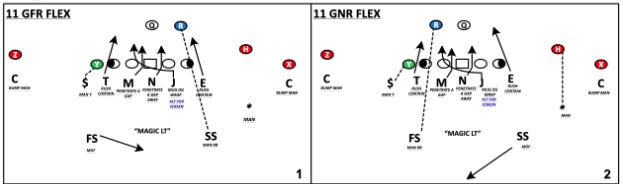
This one has a lot going on. The structure underneath is simple, but everything sitting on top of it is not.
The coverage is a three under, three deep fire zone Cover 3. That part is standard. What makes it work is the rotation. The post safety works to the strong flat after the snap while the other safety, aligned at the line of scrimmage, rotates all the way back to the post. Two safeties swapping jobs, and the quarterback has to sort it out on the move.
Up front there are two pop out players and the remaining five run one of my favorite stunt paths, Magic. The wrinkle is that the wrapper is a coffee house rusher. He gives the same look as a pop out player, sells it, then works back to rushing the passer.
The result is a free hitter against a max protection full slide look. That is the part worth sitting on. Max protection full slide is the answer to most pressure, and this one still got home clean.
Final Thoughts
Every one of these pressures produced a free hitter. The Bear builds got one. The weak overloads got one. The seven-man max pressure got one when the back stayed in to protect. The fire zone with the coffee house rusher got one against a max protection full slide look, which is the answer offenses reach for when they want to be right about everything.
That is not luck and it is not the Saints being bad. That is design. Campanile is attacking protections from a different angle on nearly every rep, and the offense keeps ending up with an unblocked defender it did not plan for. Getting a free runner once is a good call. Getting one this consistently, off this many different structures, is a coordinator who knows exactly where protections break.
What has not shown up yet is the finish. The free hitter arrives late on most of these reps, and a beat of daylight is all a quarterback needs to get the ball out. New Orleans found the curl behind the vacated overhang. They found the one-on-one when Jacksonville sent the overload. The pressure was schemed. The pressure just was not there in time.
That is a August problem, not a scheme problem, and it is the exact problem preseason exists to fix. The reads have to speed up, the paths have to tighten, and the guys running them have to stop thinking about the call. When that happens, the free hitter that shows up a half second late in the Superdome shows up on time in September. And a defense that already knows how to break protections becomes a defense that finishes.